There is a quiet humility to Swedish singer-songwriter, pianist and musical director Jonas Gideon that immediately disarms you.
I first met Jonas Gideon in Sweden at Lilla By Festivalen, and honestly, it felt less like an introduction and more like musical recognition.
One evening I was invited to join Jonas and legendary guitarist Janne Schaffer on stage for a tribute to our mutual friend and Swedish icon Ted Gärdestad. There was something deeply moving about standing there together in music, honouring Ted’s spirit and songs.
 From that moment on, Jonas and I simply kept writing. Songs seemed to arrive naturally between us — across oceans, time zones, voice notes, piano sketches, lyric ideas and late-night inspirations. Since that first meeting, we’ve collaborated on almost ten songs together, including much of my Hiraeth project, and somehow the songs just keep coming.
Despite a career that now spans international touring, acclaimed tribute productions, major concert halls, festivals, recording sessions, funerals, retirement homes and collaborations with some of Sweden’s most respected musicians, he still speaks about music with the same wonder and emotional honesty of a child discovering a piano for the very first time.
And perhaps that is precisely the point.
Because somewhere inside the accomplished performer, arranger, teacher, musical director and songwriter, there is still a little boy sitting quietly at the keys, trying to make sense of life through sound.
That child never left.
And maybe that is why Jonas Gideon’s music feels so profoundly human.
Music as Refuge
Jonas traces the beginning of everything back to loss.
The piano became a sanctuary.
Music became an emotional refuge early in Jonas’s life during a period of profound personal loss.
“Music became my comfort zone,” he says quietly. “When I sat down at the piano, I could wander away with my emotions and thoughts. The world disappeared.”
Decades later, he still enters that same emotional space whenever he plays.
Whether he is standing before a thousand people performing Elton John classics, touring internationally with an ABBA production, collaborating with legendary Swedish guitarist Janne Schaffer, or quietly accompanying grieving families in a Stockholm church, he says the feeling is fundamentally unchanged.
“I’m still that little boy sitting at the piano,” he reflects. “I enter another state of mind.”
It is one of the most revealing moments of our conversation — and perhaps the key to understanding the emotional depth listeners hear in his work.
Because Jonas Gideon does not perform at audiences.
He invites them inward.
The Scandinavian Atmosphere
There is something unmistakably Scandinavian in Jonas’s music — a sense of spaciousness, longing and emotional weather.
His songs do not rush toward resolution. They breathe.
Perhaps it comes from the landscape itself: Sweden’s long winters, luminous summers, forests, silence and shifting light.
“In winter, you long for spring,” he says. “And in summer, you begin longing for autumn again. There is always longing.”
That longing lives inside his melodies.
While Sweden is internationally famous for producing global hitmakers, Jonas belongs to another Swedish musical lineage — artists more concerned with emotional truth than formula.
“You don’t sit down to write hits,” he says. “The root is always to express yourself and your emotions.”
That philosophy permeates everything he creates.
The Mentor Who Heard the Words Inside the Music
One of the most important creative relationships in Jonas’s life began while teaching at Stockholm’s Kulturama arts school.
Jonas taught vocal performance while American songwriter Brian Hobbs taught songwriting. Their chemistry was immediate.
“In ninety minutes, we had a finished song,” Jonas recalls. “He could hear words in the nonsense syllables I was singing.”
Together they wrote nearly an album’s worth of material in a single year.
But the collaboration became something deeper than just a professional partnership.
“He became like a mentor,” Jonas says. “Like a big brother.”
The resulting album, Always Another Day, remains one of the clearest portraits of Jonas Gideon’s emotional openness as an artist.
Their final collaboration together, Holding On To Letting Go, now carries heartbreaking resonance. Written while Hobbs battled cancer, the song became both creative triumph and emotional farewell.
Even during his final weeks, Hobbs remained deeply involved in shaping the music.
Jonas remembers phoning him from the studio because he couldn’t remember a melodic adjustment Hobbs wanted in one particular verse.
“With a very weak voice, he sang the line to me over the phone,” Jonas says. “He was involved right to the very end.”
The silence after he tells that story says almost as much as the words.
Things We’ve Been Taught
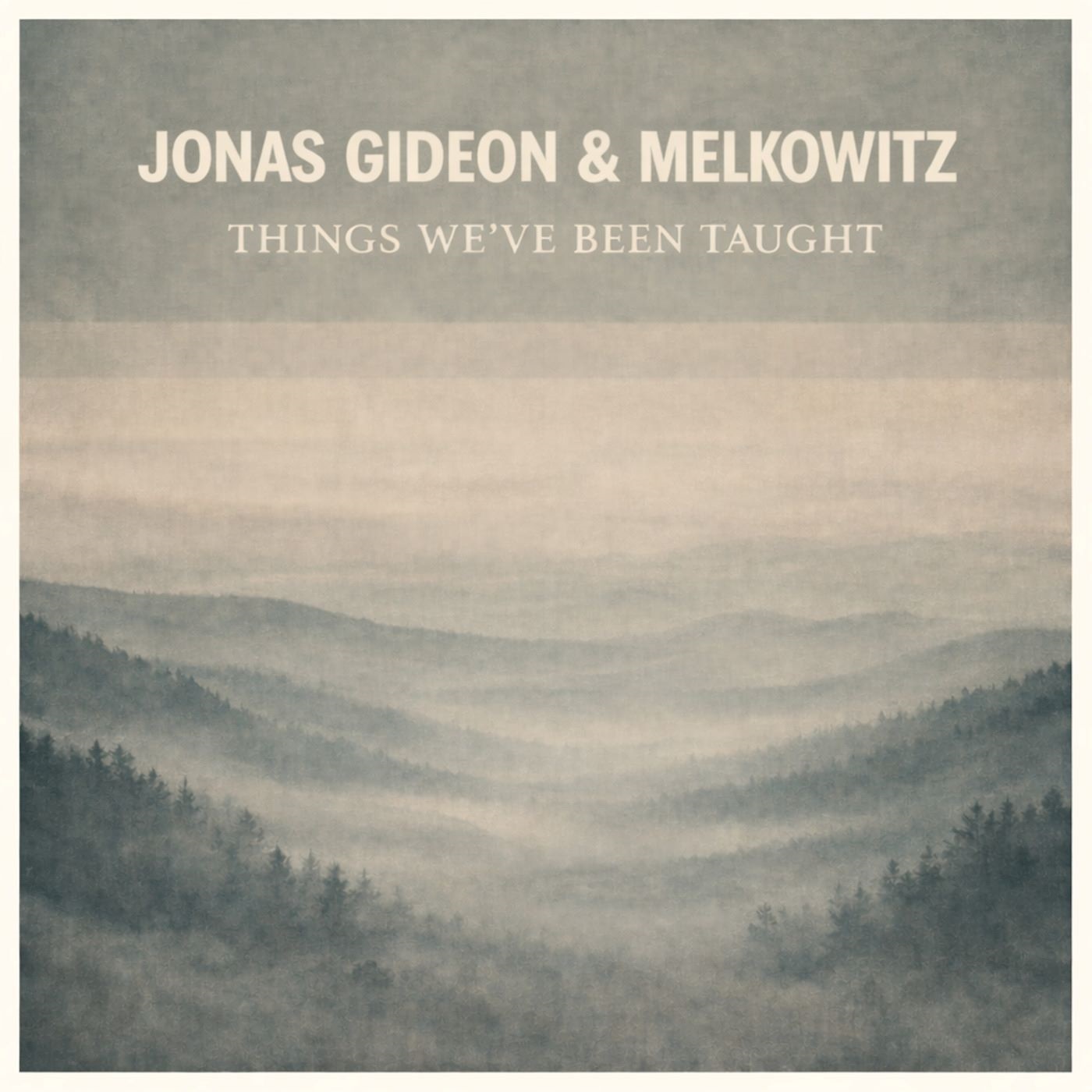
Jonas’s newest single, Things We’ve Been Taught, continues that emotional lineage.
Created with close friend and fellow musician Jakob Melkstad Melkovitz, the song emerged slowly over two years, eventually the song gradually took on deeper emotional meaning as life circumstances changed around its creation.
Listen on Spotify here: open.spotify.com/artist/2nsDCZYzP26m1iBtXcG1CA?si=52bed13d770d48b2
What began as a songwriting collaboration gradually transformed into something far more intimate.
“We really needed to finish it,” Jonas says.
The recording process was instinctive and organic: piano recorded freely without click tracks, improvised intros and endings, layered acoustic instruments, vulnerable vocals captured in living rooms and quiet studios. The recording eventually became deeply intertwined with questions of mortality, friendship and presence.
By the time the mastering session arrived, Jakob attended in a wheelchair.
“He’s a fighter,” Jonas says simply.
The song itself feels suspended between earthly struggle and spiritual acceptance. It questions the narratives society teaches us about happiness, success and meaning.
“We’re taught we need all these things,” Jonas reflects. “Instead of finding happiness within ourselves.”
Listening to it, one feels not despair, but tenderness — a deep acceptance of human fragility.
Elton John and the Joy of Performance
Though Jonas’s original music reveals his introspective side, another side of him explodes joyfully to life in his celebrated Elton John tribute concerts.
His connection to Elton John began in childhood.
At twelve years old, Jonas dressed in costume and performed Elton songs in a school talent competition. He still remembers the oversized hat, the excitement, the electricity of stepping into performance.
Elton’s music became woven into his musical DNA.
Over the years Jonas saw Elton perform live more than fourteen times before finally launching his own tribute production after Elton retired from touring.
“I wanted people to experience that music live,” he says.
Yet even here, what matters most to Jonas is not imitation, but emotional truth.
“It has to sound right,” he says. “That’s the important thing.”
Audiences have responded powerfully.
His tribute concerts now draw growing audiences across Sweden, powered not by nostalgia alone, but by genuine love for the material and a remarkable live band that captures the emotional spirit of Elton’s music.
“There’s no way I’ll ever look like Elton,” he laughs. “But I can honour the feeling.”
A Life Built Between Dream and Responsibility
Jonas Gideon describes himself as emotionally sensitive by nature — something that has shaped both his music and his life.
“Emotionally, I’ve always been very sensitive,” he says. “But suddenly having responsibilities for others — income, family, future thinking — that changes you.”
Fatherhood, touring and sustaining a creative life brought a new kind of focus and emotional maturity. Yet Jonas is quick to point out that none of it would have been possible alone.
“I’m sharing this life with the most important person in my life — my wife,” he says. “She has made it possible for this little boy to follow his dreams and continue playing and singing around the world.”
It’s also about his gratitude for being able to follow his dream because of extended family who all contribute to the care of the children while Mom and Dad work.
It is a striking image: the sensitive child who once escaped into music after grief now standing as husband, father, provider, performer and artist — somehow holding all those identities together at once.
His schedule can still be demanding. There are extended trips to Brazil, Denmark and international performances that keep him away from home for weeks at a time. Once, he spent ten days performing in Afghanistan, able to make only one brief phone call home each day.
“This is nowhere near an Elton John world-tour schedule,” he says with a laugh. “But it’s still very far from a regular nine-to-five dad life.”
And yet he believes those experiences may ultimately give his children something invaluable: permission to dream boldly.
“I think I set a good example for my kids,” he says. “To follow dreams and have a fun, exciting, special, interesting life.”
That life has taken him everywhere — from performing for homeless communities struggling with addiction to playing before the Swedish Royal Family and the King himself.
His wife, who works in hospitality at a seventeenth-century castle hotel, offers a similarly expansive example of curiosity, work ethic and human connection.
“She sets a great example too,” he says. “An interesting life combining work and pleasure and meeting lots of people.”
Together they have created a family life where creativity is not treated as fantasy, but as meaningful work.
And then comes the story that perhaps says everything about the world they’ve built together.
A few days before our conversation, Jonas’s eight-year-old daughter came home from school after a classroom discussion about what everyone’s parents did for a living.
Very proudly, she stood before her classmates and announced:
“My mom works at a castle… and my dad is Elton John.”
Jonas bursts into laughter retelling the story.
But underneath the humour is something deeply touching.
Because to his children, their father is not simply a musician.
He is someone who dared to keep the little boy at the piano alive.
The Discipline of Wonder
For Jonas Gideon, creativity is not something mystical that descends without warning.
It is practice.
Consistency.
Presence.
One of the most important lessons he says he ever learned came through Brian Hobbs.
“Brian taught me not to sit and wait for inspiration,” Jonas says. “Just sit down and start doing it.”
That philosophy also reminds him of Benny Andersson, whose legendary work ethic remains largely unchanged from ABBA’s golden era.
“Everyday Benny still goes into the studio and sits at the piano for hours,” Jonas explains. “Eventually ideas come. Fragments. A melody. A section. It’s the consistency that keeps him going.”
Jonas has adopted that same approach in his own life.
“When I sit at the piano, I almost always create something,” he says. “Maybe it’s only an A-part or a bridge. Not necessarily lyrics. But instrumentally, something always happens.”
It is perhaps the perfect description of who he is as an artist.
Not someone chasing fame or perfection.
But someone remaining faithful to the process itself.
Showing up.
Listening.
Following the emotion wherever it leads.
Teaching the Next Generation to Dream
The imagination inside the Gideon household seems to run deep.
Jonas laughs as he talks about his children’s future ambitions.
“My son wants to be a YouTuber,” he says. “And my daughter wants to put the Swedish flag on the moon because she thinks it’s a shame only the American flag is there.”
He pauses, smiling.
“Who knows what becomes of them?”
But whatever path they choose, Jonas says his message remains simple:
“As long as you work hard, don’t do anything halfway, and do the best you can, it will take you very far — and you’ll feel good about yourself.”
And if music eventually calls to them too?
“I’ll be the first one to support them,” he says. “But I never want to force them into anything.”
It is a philosophy rooted less in ambition than in freedom — allowing curiosity, creativity and individuality to unfold naturally.
Perhaps because Jonas himself understands what it means to protect that fragile spark.
The Human Heart of Music
Toward the end of our conversation, Jonas speaks passionately about the irreplaceable nature of live music.
“People don’t just want factory music,” he says. “They want something real. Something from the heart.”
He describes studies showing how audiences and performers physically synchronize during live concerts — heartbeats, breathing and emotional energy aligning together in shared experience.
“Something happens in that room,” he says. “Only there. Only then.”
And suddenly everything circles back to that little boy at the piano.
The child searching for refuge.
The teenager discovering Elton John.
The young teacher writing songs with Brian Hobbs.
The grieving friend recording with Jakob.
The performer comforting strangers through song.
The husband and father trying to build a meaningful life through creativity.
All of them still live inside the artist Jonas Gideon has become.
“I always go back to the piano,” he says near the end of our interview. “Something always happens there.”
For Jonas Gideon, music was never simply career.
It was survival.
Connection.
Healing.
Memory.
Hope.
And somewhere inside every note he plays, the little boy who first discovered, through grief and wonder, that music could become both refuge and home is still listening.
Still dreaming.
Still searching.
And perhaps one day, if his daughter has anything to say about it, still reaching all the way to the moon.
facebook.com/jonas.gideon1984
instagram.com/jonas.gideon/
jonasgideon.com
atrueeltonjohntribute.com
atrueeltonjohntribute.com/music