

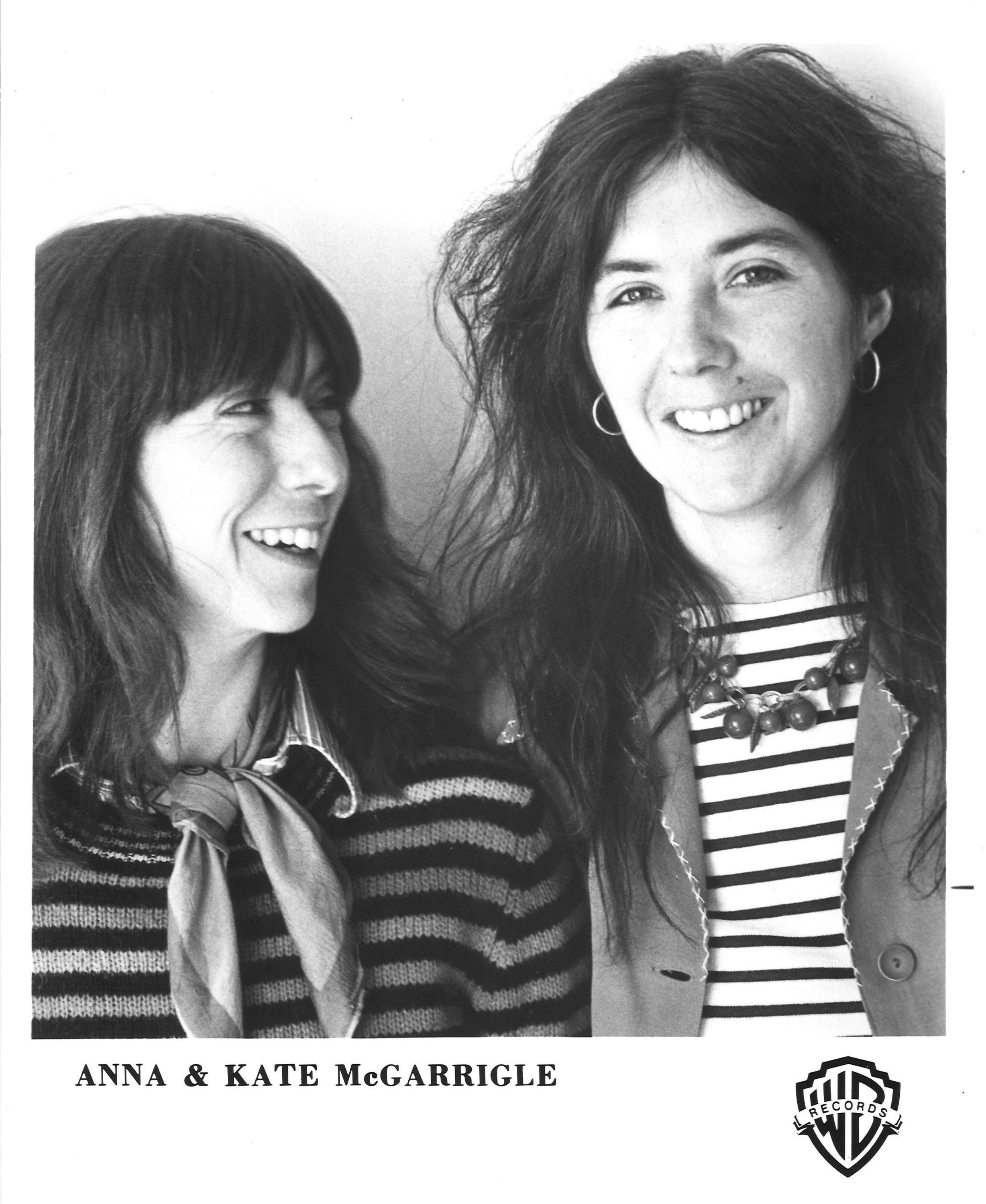
Sisters Kate and Anna McGarrigle earned a loyal international following for their unique and appealing marriage of English and French folk styles, in an era when hard rock and disco dominated. Sticking steadfastly to their own path, Kate and Anna McGarrigle made a lasting mark on roots music across North America and internationally.
Born to a French-Canadian mother and Irish father, Kate (born Catherine Frances McGarrigle in 1946) and Anna Ruth McGarrigle (born 1944) enjoyed a small-town childhood in Saint-Sauveur-des-Monts, Quebec, in a home steeped in French-Canadian folk music and timeless American music including the songs of Stephen Foster.
The sisters explain how their careers evolved: “We were taught to sing at home, but mostly we sang because we had fun. It wasn’t until much later, in our twenties, that we began singing together.”
While attending university (Kate at Montreal’s McGill University and Anna at Ecole des Beaux-Arts de Montreal), the sisters fell under the spell of the folk-music revival recordings of Bob Dylan and Joan Baez. They began performing Dylan covers with the folk group The Mountain City Four in 1963 at Montreal coffee houses. There they developed their idiosyncratic guitar- and piano-based arrangements, combining traditional Quebec folk instruments like harmonica, fiddle, and button accordion with Appalachian banjo and mandolin.
The sisters went on to bring this informal old-time sound to their music with songs such as Talk to Me of Mendicino, Love Over and Over, and Cool River. Kate explained, “I think that’s why we have an original sound. We didn’t try to imitate anyone.”
After university, Kate left Canada to explore New York City’s folk music scene, as did other Canadians like Ian and Sylvia Tyson. When Kate told her sister that others were writing their own material like Dylan and the Tysons, Anna sat down at the piano, in one afternoon composing Heart Like a Wheel, the song that became their trademark.
 Kate then turned her hand to songwriting as well, and in 1973 rising star Maria Muldaur recorded The Work Song on her hit debut album. The following year another rising star, Linda Ronstadt, recorded Heart Like a Wheel on her breakthrough album, launching the McGarrigles’ career as songwriters.
Reflecting on what Heart Like a Wheel meant to the McGarrigles, Kate’s son Rufus Wainwright explained, “My mother and aunt hadn’t planned on being professional songwriters, but when Ronstadt picked up the song, it altered their paths and accidentally led us all [including himself and sister Martha] into a life in show business.”
The McGarrigles became sought-after songwriters – but ones who had not yet recorded their own music.
By May 1974, Saint-Sauveur-des-Monts’ McGarrigle sisters were in Los Angeles, signing with Warner Brothers. Their much-admired debut album Kate and Anna McGarrigle offered an eclectic mix of folk, folk-pop, gospel, and blues, English and French lyrics.
With their names in the spotlight in North America and the U.K., where the influential “Melody Maker” magazine declared their album the best of the year, the McGarrigle sisters embarked on tours and issued well-received albums like “Dancer with Bruised Knees,” “Pronto Monto,” and “Entre la jeunesse et la sagesse” (“The French Record”). 1983’s Love Over and Over combined a contemporary rock sound with their signature roots approach, and 1990’s “Heartbeats Accelerating” offered a synth-based new wave-meets-folk sound.
Juno awards for group roots and traditional album followed in 1997, for “Matapédia” and in 1999 for “The McGarrigle Hour.”
The McGarrigles’ timeless songs have been covered by artists like Grammy-winning jazz artist Norah Jones, the timeless Nana Mouskouri, folk’s Loudon Wainwright, Ireland’s The Corrs, and many more. The McGarrigles’ producer Joe Boyd said, “That Kate and Anna McGarrigles’ songs are strong enough to support singers as diverse as Muldaur, Rufus Wainwright, and Bette Midler puts them firmly in the front rank of songwriters.”
Among other major artists who have covered the McGarrigles’ songs are Ronstadt (her 1993 cover of Love Over and Over was a chart hit) and Emmylou Harris, whose cover of Anna’s nostalgic Goin’ Back to Harlan, appeared on her Grammy-winning album “Wrecking Ball.”
In the 2000s the McGarrigles were showered with awards, including the Order of Canada and SOCAN’s Lifetime Achievement Award.
After Kate developed cancer, the sisters last performed together in 2008. Kate died in 2010.
When the sisters were awarded the Mojo Roots prize, Emmylou Harris said, “When I first heard these two ladies back in 1975…I was stunned at the beauty of their songs and the combination of their voices…. They still remain artists that stir me in my soul.”
In 2016 the McGarrigles’ debut album received the Polaris Heritage Prize. The album by two small-town Quebec sisters is now regarded as a classic of Americana roots music.
Kate And Anna McGarrigle will be inducted Into the Canadian Songwriters Hall of Fame:
Legends Series Montreal
November 17, 2025 at 8:00 p.m.
Studio Cabaret, Espace St-Denis
1594 Saint-Denis Street
ABOUT CANADIAN SONGWRITERS HALL OF FAME (CSHF)
The Canadian Songwriters Hall of Fame (CSHF) is a national and non-profit organization that is dedicated to honouring and celebrating Canadian songwriters and those who’ve dedicated their lives to the legacy of music. The CSHF also works to educate the public about these achievements and to foster the next generation of songwriters through year-round initiatives and events. In December of 2011, SOCAN (the Society of Composers, Authors and Music Publishers of Canada) acquired the CSHF; however, the Hall of Fame continues to be run as a separate organization and is guided by its own Board of Directors, comprised of both Anglophone and Francophone music creators and publishers, as well as representation from the record industry. The CSHF’s mandate aligns with SOCAN’s objectives as a songwriter and publisher membership-based organization. www.cshf.ca .
************************************************************************************
Kate et Anna McGarrigle intronisées au Panthéon des auteurs-compositeurs canadiens
Soumis par Betty Nygaard King pour le Panthéon des auteurs-compositeurs canadiens
Les sœurs Kate et Anna McGarrigle ont conquis un public international fidèle grâce à leur alliance unique et séduisante des styles folk anglophones et francophones, à une époque dominée par le hard rock et le disco. En restant fidèles à leur propre voie, elles ont laissé une marque durable sur la musique roots à travers l’Amérique du Nord et au-delà.
Nées d’une mère canadienne-française et d’un père irlandais, Kate (Catherine Frances McGarrigle, née en 1946) et Anna Ruth McGarrigle (née en 1944) ont grandi dans la petite ville de Saint-Sauveur-des-Monts, au Québec, dans une maison baignée de musique folklorique Québécoise et de chansons américaines intemporelles, dont celles de Stephen Foster.
Les sœurs expliquent comment leur carrière a évolué : « On nous a appris à chanter à la maison, mais c’était surtout pour le plaisir, » expliquent-elles. « Ce n’est que plus tard, dans la vingtaine, que nous avons commencé à chanter ensemble.
Pendant leurs études universitaires (Kate à l’Université McGill de Montréal et Anna à l’École des Beaux-Arts de Montréal), elles découvrent les enregistrements du renouveau folk de Bob Dylan et Joan Baez. En 1963, elles forment le groupe The Mountain City Four et interprètent des reprises de Dylan dans les cafés de Montréal. Elles y développent leurs arrangements singuliers, basés sur la guitare et le piano, auxquels elles ajoutent harmonica, violon, accordéon diatonique, banjo appalachien et mandoline.
Elles intègrent ce son traditionnel à leurs propres compositions, dont Talk to Me of Mendocino, Love Over and Over et Cool River. « C’est ce qui fait notre originalité : nous n’avons jamais cherché à imiter qui que ce soit », expliquait Kate.
Après leurs études, Kate part pour New York explorer la scène folk, comme Ian et Sylvia Tyson. Inspirée par le fait que d’autres écrivaient leurs propres chansons, Anna compose en une après-midi Heart Like a Wheel, qui deviendra leur pièce emblématique.
Kate se met à écrire également, et en 1973, Maria Muldaur enregistre The Work Song sur son premier album à succès. L’année suivante, Linda Ronstadt reprend Heart Like a Wheel sur son album, propulsant la carrière des McGarrigle comme auteures-compositrices.
En réfléchissant à ce que Heart Like a Wheel signifiait pour les soeurs McGarrigle, le fils deKate, Rufus Wainwright, a expliqué : Ma mère et ma tante n'avaient pas prévu de devenir des auteures-compositrices professionnelles, mais lorsque Ronstadt a découvert la chanson, leur chemin a changé et nous a tous accidentellement conduits [y compris lui et sa sœur Martha] à une vie dans le show business.
Les McGarrigles sont devenus des auteures-compositrices en demande et elles n’avaient même pas encore enregistré leur propre musique.
En mai 1974, les sœurs McGarrigle de Saint-Sauveur-des-Monts se retrouvent à Los Angeles, où elles signent un contrat avec Warner Brothers. Leur premier album, Kate and Anna McGarrigle, très admiré par la critique, propose un mélange éclectique de folk, folk-pop, gospel et blues, avec des paroles en anglais et en français.
Leur nom est alors propulsé sous les projecteurs en Amérique du Nord et au Royaume-Uni, où le magazine influent Melody Maker proclame leur disque comme le meilleur de l’année. Les sœurs McGarrigle entreprennent ensuite des tournées et sortent des albums très bien accueillis tels que Dancer with Bruised Knees, Pronto Monto et Entre la jeunesse et la sagesse (The French Record). En 1983, Love Over and Over marie un son rock contemporain à leur approche roots distinctive, tandis que Heartbeats Accelerating (1990) propose une sonorité synthétique à mi-chemin entre new wave et folk.
Des prix Juno viennent couronner leur parcours : en 1997, pour l’album Matapédia, et en 1999 pour The McGarrigle Hour.
Les chansons intemporelles des McGarrigle ont été reprises par de nombreux artistes, dont la chanteuse de jazz primée aux Grammy Awards Norah Jones, l’inoubliable Nana Mouskouri, le folkman Loudon Wainwright, le groupe irlandais The Corrs, et bien d’autres. Leur producteur Joe Boyd a déclaré : « Le fait que les chansons de Kate et Anna McGarrigle puissent être portées par des artistes aussi divers que Maria Muldaur, Rufus Wainwright et Bette Midler les place indéniablement au premier rang des auteurs-compositeurs. »
Parmi les autres grands noms qui ont interprété leurs chansons, notons Linda Ronstadt, dont la reprise de Love Over and Over en 1993 a connu un grand succès, et Emmylou Harris, qui a inclus Goin’ Back to Harlan d’Anna sur son album Wrecking Ball, lauréat d’un Grammy.
Au cours des années 2000, les McGarrigle reçoivent de nombreuses distinctions, dont l’Ordre du Canada et le Prix Hommage de la SOCAN.
Après que Kate ait développé un cancer, les sœurs se produisent ensemble pour la dernière fois en 2008. Kate est décédée en 2010.
Lorsqu’elles reçoivent le prix Mojo Roots, Emmylou Harris déclare : « Quand j’ai entendu ces deux femmes pour la première fois en 1975... j’ai été bouleversée par la beauté de leurs chansons et la fusion de leurs voix... Elles demeurent encore aujourd’hui des artistes qui me touchent au plus profond de l’âme. »
En 2016, leur premier album reçoit le Prix Patrimoine Polaris, consacrant cet opus de deux sœurs originaires d’un petit village québécois comme un classique de la musique roots américaine.